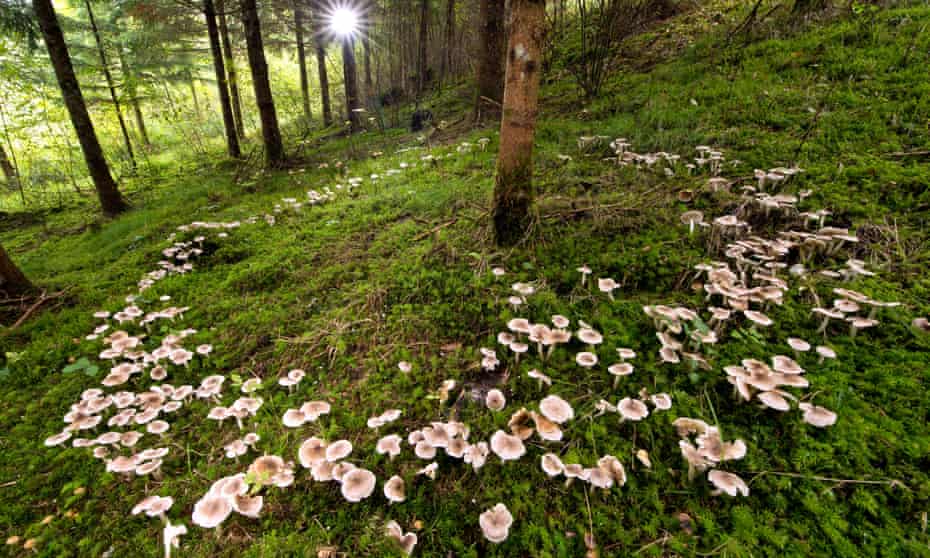
Read the article and answer the questions:
1. What function do fungi perform in relation to plants?
2. What is the length of underground fungal networks?
3. In which regions of the world can the fungal networks be found?
Read the article and answer the questions:
1. What function do fungi perform in relation to plants?
2. What is the length of underground fungal networks?
3. In which regions of the world can the fungal networks be found?

click here to read the article

Read the article and answer the questions:
1) What position did Frances Haugen occupy in Facebook?
2) What was the turning point for her to become a whistleblower?
3) What did she accuse Facebook of?
4) Where were her revelations published?
5) What changes were announced by Facebook?
6) What solution did Frances offer?
Pun is a joke exploiting the different possible meanings of a word or the fact that there are words which sound alike but have different meanings.
1. A man was severely hurt as a pile of books fell on him in the library. Apparently, he only has his shelf to blame.
2. As I struggled in the class with a half pencil, my teacher looked at me and said, "Writing with a broken pencil is pointless, my child."
3. The comma said, "I think we should slow down for a while." The full stop replied, "We'd rather just stop right now!"
4. Did you know, seven days without a pun can make one weak?
5. My friend said he is terrific friends with 25 letters of the alphabet, but he doesn't know Y.
6. My sister said, "I stayed up the whole night to see where the sun went, then it finally dawned on me." She's great with her grammar for sure.
7. My teacher always says, "Double negatives are a big no-no."
8. My teacher avoids cliches like the plague!
9. When in class, my teacher called me and said, "Name 2 pronouns." Alarmed, I said, "Who, me?"
10. When my teacher asked what I want to do during the vacation, I said, "Go to Italy, Rome around and pasta time." I am one of her favorite students now.
11. At night, an owl said, "Whom" instead of who, and my father exclaimed, "Now, that's a classy owl right there."
If you like puns, post them in the commentary section below.
Grammar explanation
Participle clauses enable us to say information in a more economical way. They are formed using present participles (going, reading, seeing, walking, etc.), past participles (gone, read, seen, walked, etc.) or perfect participles (having gone, having read, having seen, having walked, etc.).
We can use participle clauses when the participle and the verb in the main clause have the same subject. For example,
Waiting for Ellie, I made some tea. (While I was waiting for Ellie, I made some tea.)
Participle clauses do not have a specific tense. The tense is indicated by the verb in the main clause.
Participle clauses are mainly used in written texts, particularly in a literary, academic or journalistic style.
Here are some common ways we use present participle clauses. Note that present participles have a similar meaning to active verbs.
Here are some common ways that we use past participle clauses. Note that past participles normally have a passive meaning.
Perfect participle clauses show that the action they describe was finished before the action in the main clause. Perfect participles can be structured to make an active or passive meaning.
Having got dressed, he slowly went downstairs.
Having finished their training, they will be fully qualified doctors.
Having been made redundant, she started looking for a new job.
Read the explanation and make up 5 sentences including participles. Post them in the commentary section.
Watch the interview and answer the question: What problem does Angelina raise in her acceptance speech?