Wednesday, 13 January 2021

15 Words to Use Instead of Very

 Here's a list of words you can use instead of very.

  1. 1. furious – very angry
    Michael was furious when he found out someone hit his car.

  2. 2. awful – very bad

  3. The garbage can smells awful! Take it out.

  4. 3. adorable – very cute

  5. That's an adorable puppy!

  6. 4. gorgeous – very beautiful
    Sarah wore a gorgeous red dress to the party.

5. comprehensive – very complete
He gave a comprehensive report on the project.

  1. 6. swamped – very busy
    I'm swamped with work for months.

  2. 7. effortless – very easy
    We went on an effortless hike to the waterfalls.

  3. 8. massive – very big
    The sun is a massive star that measures 1,392,000 kilometers in diameter. 

  4. 9. perilous – very dangerous
    Mount Everest is a perilous mountain to climb.

  5. 10. filthy – very dirty
    Change your shirt. It's filthy!

    1. 11. ecstatic – very happy
      Paul was ecstatic to find out that his wife was pregnant.

    2. 12. obese – very fat
      At 140 kilos, Bryant was an obese man.

    3. 13. exhilarating – very exciting
      Running can be an exhilarating experience.

    4. 14. crucial – very important
      Exercise is crucial for maintaining good health.

    5. 15. wealthy – very rich
      Bill Gates, the founder of Microsoft, is a wealthy man.

    For more words, check out this 128-word list. Practice using the words in a sentence!

    Make up 5 sentences with the words from the list and post them in the commentary section.


Wednesday, 23 December 2020

What makes a good life? Lessons from the longest study on happiness

 Watch the video and answer the questions:


1.What did millennials consider their life goal?

2.How long did the Harvard Study of Adult Development last?

3.How many participants did it involve?

4. What methods did the study employ?

5.What  makes people happy, according to the study?


Post your answers in the commentary section.

Friday, 11 December 2020

Cocos Islands TERRITORY, AUSTRALIA

Read the article, watch the video bellow and answer the questions:

1. Where are the Cocos Islands located?
2. What can you say about the popuation of the islands?
3. What is the economy of the islands based upon?
4. Who governs the islands?
5. When did the islands pass to Australia?

Cocos Islands, officially Territory of Cocos (Keeling) Islands, also called Keeling Islands, external territory of Australia in the eastern Indian Ocean. The islands lie 2,290 miles (3,685 km) west of Darwin, Northern Territory, on the northern Australian coast, and about 560 miles (900 km) southwest of Christmas Island (another external territory of Australia). The isolated territory is made up of two coral atolls, the southern comprising 26 islets and the northern containing only North Keeling Island. The territory’s administrative headquarters are on West Island in the southern atoll. Total land area 5 square miles (14 square km). Population (2016) 544.

Land

North Keeling Island is located about 15 miles (24 km) north of the main lagoon (South Lagoon), which is surrounded by the numerous islets of the South Keeling Islands. The principal islands of the South Keelings include West Island (the largest in the territory, with a length of 6 miles [10 km]), South, Home, Direction, and Horsburgh. The land is low, with the highest point in the territory rising to only about 20 feet (6 metres) above sea level. The climate is warm and humid; temperatures range from 77 to 84 °F (25 to 29 °C), and annual rainfall averages 78 inches (1,970 mm). Destructive cyclones may strike the area early in the year, and earthquakes occur periodically. The vegetation consists chiefly of coconut palms, which were formerly cultivated for copra on plantations; on North Keeling and Horsburgh islands, coarse grass serves as a ground cover. There are no indigenous mammals, but seabirds abound, as do land crabs. As the location of several rare ecosystems—including an intact coral atoll environment—and a notable seabird breeding ground, North Keeling Island and its surrounding waters were designated a protected area, Pulu Keeling National Park, in 1995.

People

The inhabitants are predominantly the descendants of the original plantation workers, mostly of Malay origin, who were brought to the islands by John Clunies-Ross, a Scotsman, in 1827–31. Some four-fifths of the population—Cocos Islanders, or Cocos Malays, as they are often called, together with the descendants of the Clunies-Ross family—live on Home Island. Most of the Cocos Malays speak a dialect of Malay and are Muslim. Numerous Cocos Islanders moved to the Australian mainland in the mid-1950s because of overcrowded conditions on the islands; they settled mainly in the state of Western Australia.
The remainder of the Cocos Island population resides on West Island and consists mostly of mainland-recruited employees of the territory administration, together with their families; most are there on short-term postings. The majority of the people are engaged in maintaining the coconut plantations on Home and other islands in the group. A small number of others are permanent residents working in small businesses.

Economy

The production and export of copra is the territory’s economic mainstay. The Cocos Islands Co-operative Society Ltd., established in 1979, undertakes building maintenance and construction and provides stevedoring, interisland transport, lighter on- and off-loading, and other services. Although fishing is good and the islanders have gardens, much of the food must be imported, as must fuels and consumer goods. High unemployment rates are a continuing problem.
An airstrip, built on West Island in 1945, was used until 1967 as a stopping place on flights between Perth, Austl., and Johannesburg, S.Af. Several regular passenger flights connect the islands with Perth and with Christmas Island. Meteorological reports from the Cocos are important in forecasting weather for a large area of the Indian Ocean.


Government And Society

An administrator appointed by the Australian governor-general is the senior governmental official in the Cocos. The islands became an Australian territory under the Cocos (Keeling) Islands Act 1955. In 1979 the residents of Home Island established the Cocos Islands Council to administer local affairs. In 1984 the Cocos Islanders voted in favour of political integration with Australia. The Territories Law Reform Act of 1992 amended the Cocos (Keeling) Islands Act, expanding local authority and applying the legal structure of Western Australia to the territory. The act provides for a Shire Council, which replaced the Cocos Islands Council and administers most local government services; many other services are provided through agencies of the Western Australia state government. Cocos Islanders vote in federal elections as part of the electoral district of Lingiari, in the Northern Territory.


History

The islands were uninhabited at the time of their first European sighting, in 1609 by the English mariner William Keeling, who was working for the East India Company. They were settled (1826) by an English adventurer named Alexander Hare, who brought his Malay harem and slaves. In 1827 John Clunies-Ross settled there with his family, improved the natural coconut groves, and brought in additional numbers of Malays to assist in harvesting the coconuts for copra. The English naturalist Charles Darwin made observations of the coral reefs there in 1836.
Declared a British possession in 1857, the Cocos were placed under the governor of Ceylon (present-day Sri Lanka) in 1878. The islands were attached to the Straits Settlements in 1886 and were granted in perpetuity to the Clunies-Ross family. In 1903 the Cocos were attached to the British crown colony of Singapore. During World War I the German cruiser Emden was overwhelmed (1914) by the Australian cruiser Sydney and beached itself on the reefs off North Keeling. The islands passed from British Singapore to Australia in 1955. In September 1978 the owner, John Clunies-Ross, sold most of his property and relinquished his authority over the islands to Australia, which introduced Australian currency and took steps toward establishing Cocos Malay self-government. In a 1984 referendum on the future political status of the islands, the residents voted for full integration with Australia. The islands’ leaders signed a Memorandum of Understanding with the Australian government in 1991, which described measures designed to bring the Cocos’ standard of living in line with that of mainland Australia. The Clunies-Ross family sold its remaining Home Island property to Australia in 1993.

Friday, 27 November 2020

10 Top Tourist Attractions in Canada

 Canada is a country that has much to offer visitors, from island sights to scenic mountain waterfalls. Stretching from the Atlantic to the Pacific coasts, this former French and British colony has a rich heritage from the North Coast Indians of British Columbia to the French explorers of Quebec. Since both French and English are the national languages, a visit to Canada is like visiting two countries. Indeed, Canada has appeal for travelers who are interested in nature and cosmopolitan cities. An overview of the top tourist attractions in Canada:

Canada is a country that has much to offer visitors, from island sights to scenic mountain waterfalls. Stretching from the Atlantic to the Pacific coasts, this former French and British colony has a rich heritage from the North Coast Indians of British Columbia to the French explorers of Quebec. Since both French and English are the national languages, a visit to Canada is like visiting two countries. Indeed, Canada has appeal for travelers who are interested in nature and cosmopolitan cities. An overview of the top tourist attractions in Canada:

10. Gros Morne National Park

Gros Morne National Parkflickr/VisitGrosMorne

Gros Morne National Park in Newfoundland is important to the world, geologically, because the ancient rocks help people understand how the oceans and continents were created. The park is a nature lover’s paradise featuring lowlands along the Gulf of St. Lawrence and the alpine setting of the Long Range Mountains. The park is popular with wildlife viewers who’ll see everything from tiny songbirds to giant whales; black bears, moose and deer are common. Most visitors come here during the short summer season. The exception is the peak winter season (from February to April), when the park experiences another mini-boom in snowmobiling and cross-country skiing.

9. Calgary Stampede

The Calgary Stampede, one of the most famous rodeos in the world, traces its origins back to the traveling wild west shows of the late 1800s and early 1900s. The Stampede has grown over the years, today attracting the best cowboys in the world who compete for $2 million in prize money. Other activities include live concerts, a carnival, lots of food and dancing as this Canadian city hosts the best in the west. A 4 km (2.5 mile) parade opens what Calgary calls “the greatest outdoor show on earth”. The 10-day event is held every July.

8. Victoria's Inner Harbour

Victoria's Inner Harbour

Victoria’s Inner Harbour on Vancouver Island is a cool place to visit. There’s the water on one side and stately government buildings on the other since Victoria is the capital of British Columbia. The city hosts a classic boat festival on Labour Day in September, with the harbor filling up with wooden boats. Visitors can also navigate the harbor on kayaks or tour boats. Take time out to have a traditional British tea at the Empress Hotel, a Victoria landmark since the early 1900s; it’s right across from the harbor.

7. Bay of Fundy

Bay of Fundy

The Bay of Fundy, located on the Atlantic coast in eastern Canada, is famous for its high tidal range. Because of the unique shape of the bay, the difference in water level between high tide and low tide can be as much as 16 meters (52 feet). One of the best places to watch the tides are the Hopewell Rocks, a number of sandstone towers topped by trees. The base of the rock formations are covered in water twice a day and can be seen from the ground level at low tide.

6. Athabasca Falls

Athabasca Fallsflickr/gcD600

Jasper National Park in the Alberta province is the largest of Canada’s Rocky Mountain Parks boasting broad valleys, rugged mountains, glaciers, forests, alpine meadows and wild rivers. One of the top attractions is Athabasca Falls, a beautiful waterfall that thunders through a narrow gorge. Even when the water level in the upper Athabasca River is low, huge quantities of water pour over the falls. Several viewing platforms and trails where it is safe to photograph the picturesque scene are located around the falls. Motorists can cross over the falls by taking Highway 93A into the town of Jasper.

5. Churchill

Churchill

It may only be a small town of 1,000 residents in the Manitoba province on the Hudson Bay shore, but Churchill draws huge crowds every year to see its most famous inhabitants, the polar bears. Nicknamed the “Polar Bear Capital of the World,” it is one of the top tourist attractions in Canada. In addition to polar bears, Churchill is also a popular place for viewing beluga whales, birds and the aurora borealis.

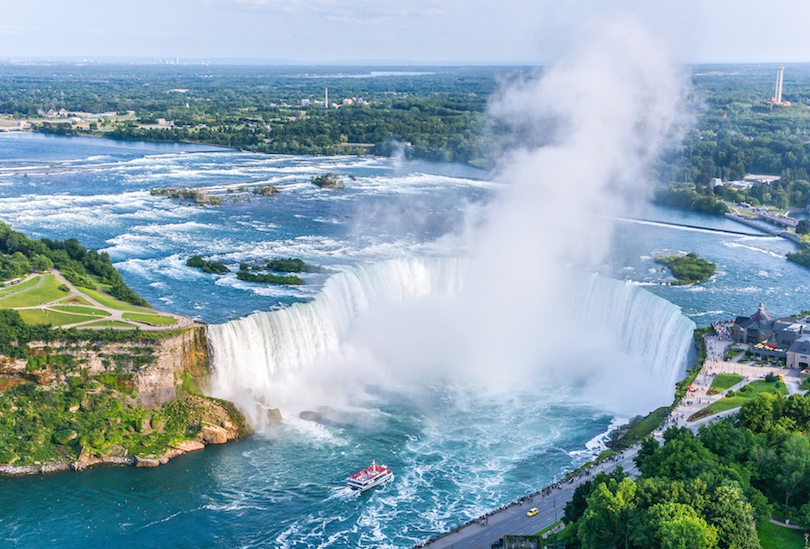
4. Niagara Falls, Ontario

Niagara Falls, Ontario

Many Americans think of Niagara Falls as being only a waterfall in the United States, namely New York, when in actuality, Niagara Falls is three falls on the border between the United States and Canada. Horseshoe Falls is the largest falls and is located mainly on the Canadian side, while the smaller American and Bridal Veil falls are mostly on the U.S. side. Combined, the three falls have a higher flow rate than any other in the world. About 20 million people visit here annually, with many of them taking a boat ride on Maid of the Mist, the falls’ oldest attraction.

3. The Canadian

The Canadianflickr/Madbuster75

Travelers looking for a relaxing way to cross Canada may want to consider the train, in this case, the Canadian. Connecting Toronto and Vancouver, this is one of the world’s more famous train rides, traveling through the lakes of northern Ontario, the prairie provinces and the Canadian Rockies including Jasper National Park, to end at the cosmopolitan city of Vancouver. It takes 3 days to cover the 4,466 kilometers (2,775 miles) connecting the two cities. Via Rail recently spent $22 million modernizing the train.

2. Vieux-Quebec

Vieux-Quebecflickr/Artur Staszewski

Vieux-Québec, or Old Quebec, is an historic district in Quebec City. This is where the French explorer Samuel de Champlain founded Saint Louis Fort in 1608. The military presence here was strong under both the French and the British, with the area being heavily fortified. Today it is a tourist district with many small boutiques and hundreds of historical and photographic points of interest. Visitors will want to take in the Citadel, known as she “Gibraltar of the Americas,” because of its strategic location overlooking the St. Lawrence River. Visitors also will want to take in the iconic Chateau Frontenac, and enjoy the charm of European style shopping on Rue Saint Jean.

1. Moraine Lake

#1 of Tourist Attractions In Canada

Moraine Lake, in Banff National Park is one of the most photographed places in western Canada. This glacier-fed lake is a gorgeous blue-green surrounded by mountains in Alberta. It’s located in the Valley of the Ten Peaks at an elevation of 1,885 meters (6,183 feet). The Rockpile Trail is popular with tourists who snap their photos at its end. At one time this alpine lake was featured on Canada’s $20 bill, earning this site the nickname of Twenty Dollar View. Other hiking trails offer spectacular views of the lake; visitors can get a different view by canoeing in it.

Thursday, 19 November 2020

Wish + verb forms in the that-clause


The verb forms we use in that-clauses after wish are similar to the verb forms in conditional clauses after if. We use a past verb form for present and future meanings.

Compare

if

wish

It would be good if we had a bigger car.

I wish we had a bigger car.

It would be good if I knew how to use this DVD player.

I wish I knew how to use this DVD player.

When we wish something about the past, we use the past perfect after wish:

I wish I had known Charlie was coming. I would have invited Jane. (I didn’t know it and did not invite Jane.)

I wish I hadn’t said that. I can see I’ve upset you. Sorry. (I did say it; it would have been better if I had not said it.)

Wish + would

We can use wish + would if we are annoyed about something that is or is not happening, or about something that will or will not happen:

I wish you’d stop making so much noise! (You are making a noise; it would be better if you didn’t.)

I wish you wouldn’t come through the kitchen with your dirty boots on. (You do come through the kitchen; it would be better if you didn’t.)

In informal situations, we can use wish in the continuous form like this:

He’s embarrassing everyone. I’m just wishing he would go away!


Make up 3 sentences with 'wish' and post them in the commentary section below. 

Angelina Jolie receives the Jean Hersholt Humanitarian Award at the 2013 Governors Awards

  Watch the interview and answer the question: What problem does Angelina raise in her acceptance speech?