Friday, 17 December 2021

Efforts to save Iran nuclear deal ‘reaching the end of the road’

click here 


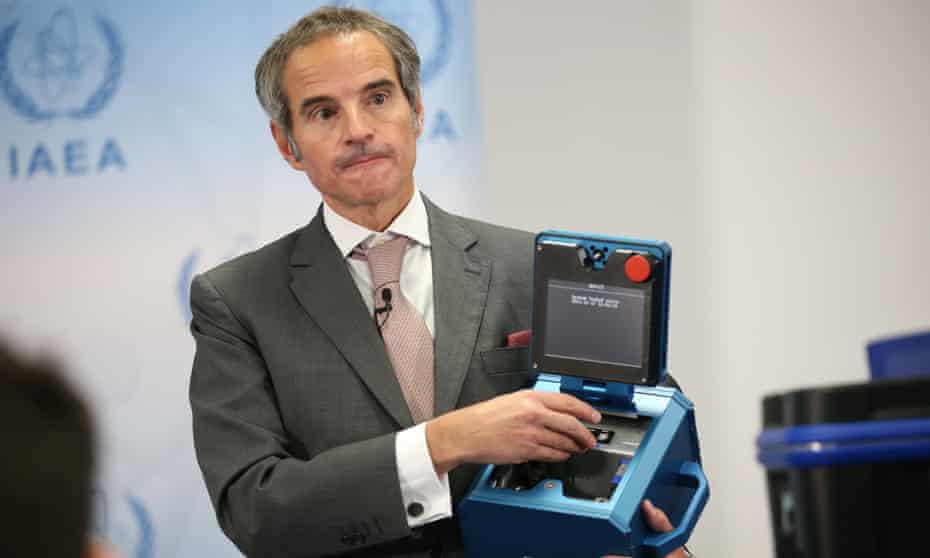
Rafael Grossi displays the camera system to be used in Iran’s Karaj nuclear facility at a press conference in Vienna on Friday.

Read the article and answer the questions:

1. What changes have there occurred in the relations between Europe and Iran since the 2015 Iran nuclear deal?

2. What policy does the US pursue in this matter? 

3. What happened to the IAEA cameras placed at Karaj near Tehran?

Sunday, 12 December 2021

Deadly Tornado Hits Multiple States


This should be a reminder to those capable of understanding. Fear Allah the way He should be feared.

Kentucky tornadoes: up to 100 feared dead in historic US storms

 click here


An aerial view of the city of Mayfield in Kentucky after a tornado struck. More than 20 tornadoes have caused destruction across southern and central states in the US.

Read the article and answer the questions:

1. What do you know of the level of devastation caused by the latest US tornado?

2. What was Biden's reaction to the event?

3. What was the reaction of the witnesses and survivors?

Phrasal Verbs

 Look at these examples to see how phrasal verbs are used.

This is the form. Please can you fill it in?
Why are you bringing that argument up now?
Police are looking into connections between the two crimes.
We need to come up with a solution.

Phrasal verbs are very common in English, especially in more informal contexts. They are made up of a verb and a particle or, sometimes, two particles. The particle often changes the meaning of the verb.

I called Jen to see how she was. (call = to telephone)
They've called off the meeting. (call off = to cancel)

In terms of word order, there are two main types of phrasal verb: separable and inseparable. 

Separable

With separable phrasal verbs, the verb and particle can be apart or together.

They've called the meeting off.
OR
They've called off the meeting.

However, separable phrasal verbs must be separated when you use a pronoun. 

The meeting? They've called it off.

Here are some common separable phrasal verbs:

I didn't want to bring the situation up at the meeting.
(bring up = start talking about a particular subject)

Please can you fill this form in?
(fill in = write information in a form or document)

I'll pick you up from the station at 8 p.m.
(pick up = collect someone in a car or other vehicle to take them somewhere)

She turned the job down because she didn't want to move to Glasgow.
(turn down = to not accept an offer)

Non-separable

Some phrasal verbs cannot be separated. 

Who looks after the baby when you're at work?

Even when there is a pronoun, the verb and particle remain together.

Who looks after her when you're at work?

Here are some common non-separable phrasal verbs:

came across your email when I was clearing my inbox. 
(come across = to find something by chance)

The caterpillar turned into a beautiful butterfly. 
(turn into = become)

It was quite a major operation. It took months to get over it and feel normal again. 
(get over = recover from something)

We are aware of the problem and we are looking into it. 
(look into = investigate)

Some multi-word verbs are inseparable simply because they don't take an object.

get up at 7 a.m.

With two particles

Phrasal verbs with two particles are also inseparable. Even if you use a pronoun, you put it after the particles.

Who came up with that idea? 
(come up with = think of an idea or plan)

Let's get rid of these old magazines to make more space. 
(get rid of = remove or become free of something that you don't want)

I didn't really get on with my stepbrother when I was a teenager.
(get on with = like and be friendly towards someone)

Can you hear that noise all the time? I don't know how you put up with it. 
(put up with = tolerate something difficult or annoying)

The concert's on Friday. I'm really looking forward to it. 
(look forward to = be happy and excited about something that is going to happen)

Read the explanation and make up 5 sentences with phrasal verbs.
Sunday, 5 December 2021

Complex Subject


Noun/Pronoun + Predicate + Infinitive
The combination of a noun in the common case (or a pronoun in the nominative case) and an infinitive forms a complex subject.
The predicate which is usually expressed by a verb in the passive voice  is placed between the noun and the infinitive. The relation between the noun and the infinitive is that of subject and predicate.


The predicate in sentences with a complex subject can be expressed by:

1. The same verbs that can be followed by a complex object  (that is verbs of sense perception: to see, to hear…, verbs of mental activity: to know, to suppose…; verbs of inducement: to order, to cause, to allow…,). The verbs are used in the passive voice.

Patterns.
  1. He was supposed to bring this book from London. (Predicate is underlined.) 
  2. They are heard to have come from the South. 
  3. They were seen to go home together. This article is expected to be published next month.
2. verbs of saying: to say, to report, to announce... in the passive voice.

Patterns.
  1. The building of the new hostel is reported to be over
  2. He was said to be writing a new play.

3. the verbs to seem, to appear, to prove, to happen, to turn out, to chance  in the active voice. 
  1. The telephone happened to be out of order. 
  2. The young man proved to know everybody. 
  3. The house seems to have been damaged by the earthquake.
4. compound predicate: to be likely, to be unlikely, to be sure, to be certain, to be bound
  1. They are likely to return on Sunday. 
  2. Their team is certain to win. / Their team is bound to win
  3. He is sure to miss this train. 
  4. This house is likely to have been built many centuries ago.

Read the information above and make up 5 sentences with Complex Subject.

A decade of marketisation has left lecturers with no choice but to strike

click here 


Lecturers picket University College London, 1 December

Read the article and answer the questions:

1. What was the reason for the strike?

2. How do you understand the term 'casualisation'?

3. Who insisted on reduction in staff costs and why?

4. Do you think reduction is the solution?


Wednesday, 1 December 2021

List of examination topics for the 3rd year students

 1. My meals

2. Higher education in Great Britain

3. The book I've recently read

4. My last visit to the doctor

5. The country I would like to visit

6. Choosing a career

7. London

8. Russia

9. My favorite film

10. Happy topic

Angelina Jolie receives the Jean Hersholt Humanitarian Award at the 2013 Governors Awards

  Watch the interview and answer the question: What problem does Angelina raise in her acceptance speech?